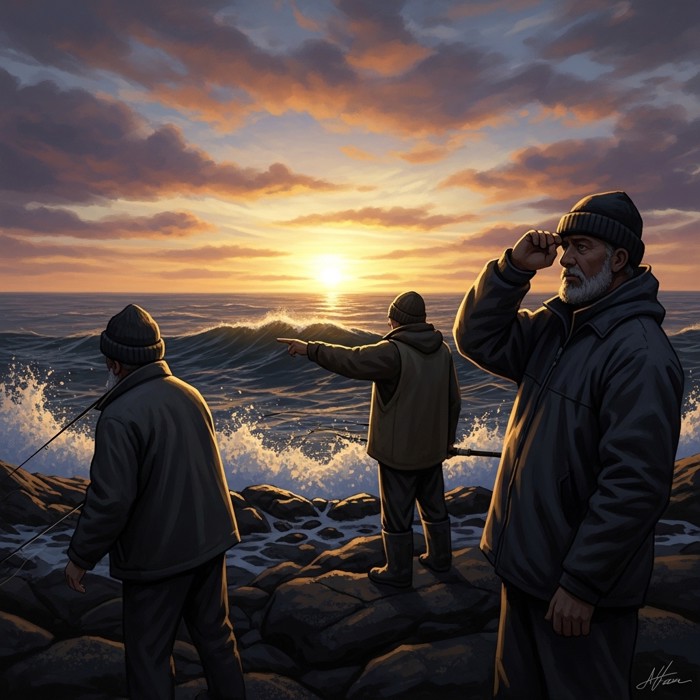
How Fishers Read the Ocean
25 Jul, 2026
Level: Intermediate
Total vocabularies: 138
Minutes to read: 2
Topic: The Ocean
You can click on the Play game and explore button below to learn more interesting knowledge.
Before sunrise, fishers stand at the shore and watch the ocean carefully.
They are not just looking at water - they are reading signs that most people never notice.
Experienced fishers can predict where fish are hiding by studying the ocean's surface.

Underwater view of sunlight filtering through murky green water teeming with tiny organisms and fish shadows near a coral shelf.
The color of the water gives important clues about what lies below.
Dark blue water is often deep and cold, while green water usually means shallow areas full of nutrients .
When fishers spot seabirds diving repeatedly into one spot, they know fish are near the surface.
Birds follow schools of small fish, so where birds dive, larger fish often feed below.

A lone fisher on a wooden boat watching a mesmerizing pattern of rolling swells moving across a deep blue open sea.
The movement of waves also tells fishers about the weather and wind direction.
Short, choppy waves mean a local wind is blowing, while long, rolling waves come from storms far away.
Fishers also watch for foam lines and floating seaweed on the surface.

These lines form where two ocean currents meet, and fish gather along these boundaries to feed.
An underwater photo of a silver school of fish bursting upward toward the surface, with a dark predator shape visible below.
If fish are jumping out of the water, it often means predators are chasing them from below.
Experienced fishers track the tides because fish feed more actively when water is moving.
This knowledge is passed down through generations and takes years to learn properly.
Understanding the ocean helps fishers work more safely and catch fish more efficiently .